Most property developers don’t have a lead generation problem. They have a lead quality problem.
The distinction matters more than it might appear. A sales team buried in enquiries from unqualified prospects spends its time on administration, not conversion. Marketing budgets get consumed chasing volume. Sales pipelines look healthy on paper while reservation rates remain stubbornly low. The underlying issue isn’t reach, it’s relevance.
This is the central tension at the heart of marketing for property developers operating in the UAE today. Buyers are more informed than at any point in recent history. According to NAR’s research, 96% of homebuyers use online tools during their property search, and the median buyer now spends around 10 weeks researching before committing. In the UAE, where international buyers account for a significant share of transactions, particularly in Dubai and Abu Dhabi, that research cycle is often considerably longer, spanning multiple markets and jurisdictions. A development that captures an enquiry in week one is rarely the development that closes the reservation in week ten, unless its marketing strategy is built to sustain that relationship.
The developers generating the best-qualified leads have stopped thinking about marketing as a volume exercise. They have rebuilt their approach around precision: better positioning, more deliberate channel selection, tighter buyer segmentation, and a clearer understanding of what a sales-ready lead actually looks like.

Why Marketing for Property Developers in the UAE Struggles With Lead Quality
The structure of property development marketing has historically rewarded quantity. Portal advertising on platforms like Bayut and Property Finder, display campaigns, and broad social media reach all optimise for volume by default. The more enquiries a development generates, the more confident the team feels about its marketing spend. The problem is that this logic works until it doesn’t, and in competitive submarkets like Dubai Marina, Downtown Dubai, or Palm Jumeirah, it usually stops working at exactly the wrong moment.
Let’s work together
Start a Strategic Partnership
Contact Us Partnership
Hogi website is protected by reCAPTCHA and the Privacy Policy and Terms of Service apply.
By submitting this form, you agree that HOGI may contact you regarding your inquiry, updates, and offers.
You can withdraw your consent at any time. Please see our Privacy Policy for more information.
Buyer journeys have extended and fragmented. The UAE draws buyers from over 200 nationalities, many of whom are evaluating Dubai or Abu Dhabi alongside comparable markets in London, Singapore, or Lisbon. Knight Frank’s Wealth Report 2026 documented how private capital is adapting to a more complex geopolitical landscape, which has made high-net-worth buyers more deliberate and more demanding in their purchase criteria. These are not impulsive buyers. They conduct extensive due diligence, compare multiple developments, consult advisors, and frequently pause mid-process due to macroeconomic or personal factors.
The information available to buyers has also expanded dramatically. DLD transaction records, developer track records, construction timelines, service charge histories, and comparative pricing data are all accessible before a buyer ever makes contact. By the time a prospect submits an enquiry, they have often already formed a strong view of the development’s positioning. Developers who fail to control that narrative arrive at the sales conversation at a disadvantage. Effective marketing for property developers means controlling that pre-contact narrative deliberately, not leaving it to chance.
The Difference Between Lead Volume and Qualified Leads
The terminology in property marketing is often used loosely, which creates ambiguity in how success is measured.
A marketing-qualified lead (MQL) is a prospect who has engaged meaningfully with marketing content: visited key website pages, downloaded a brochure, opened multiple email communications, or attended a virtual event. MQLs indicate genuine interest but not necessarily purchase readiness. They are prospects worth nurturing, not yet worth the full attention of the sales team.
A sales-qualified lead (SQL) is a prospect who has demonstrated sufficient readiness to justify direct sales engagement. In a UAE development context, that typically means a buyer who has confirmed their budget, timeline, and primary motivation, whether end-use, investment yield, or residency visa eligibility, and who represents a realistic reservation opportunity within a defined period.
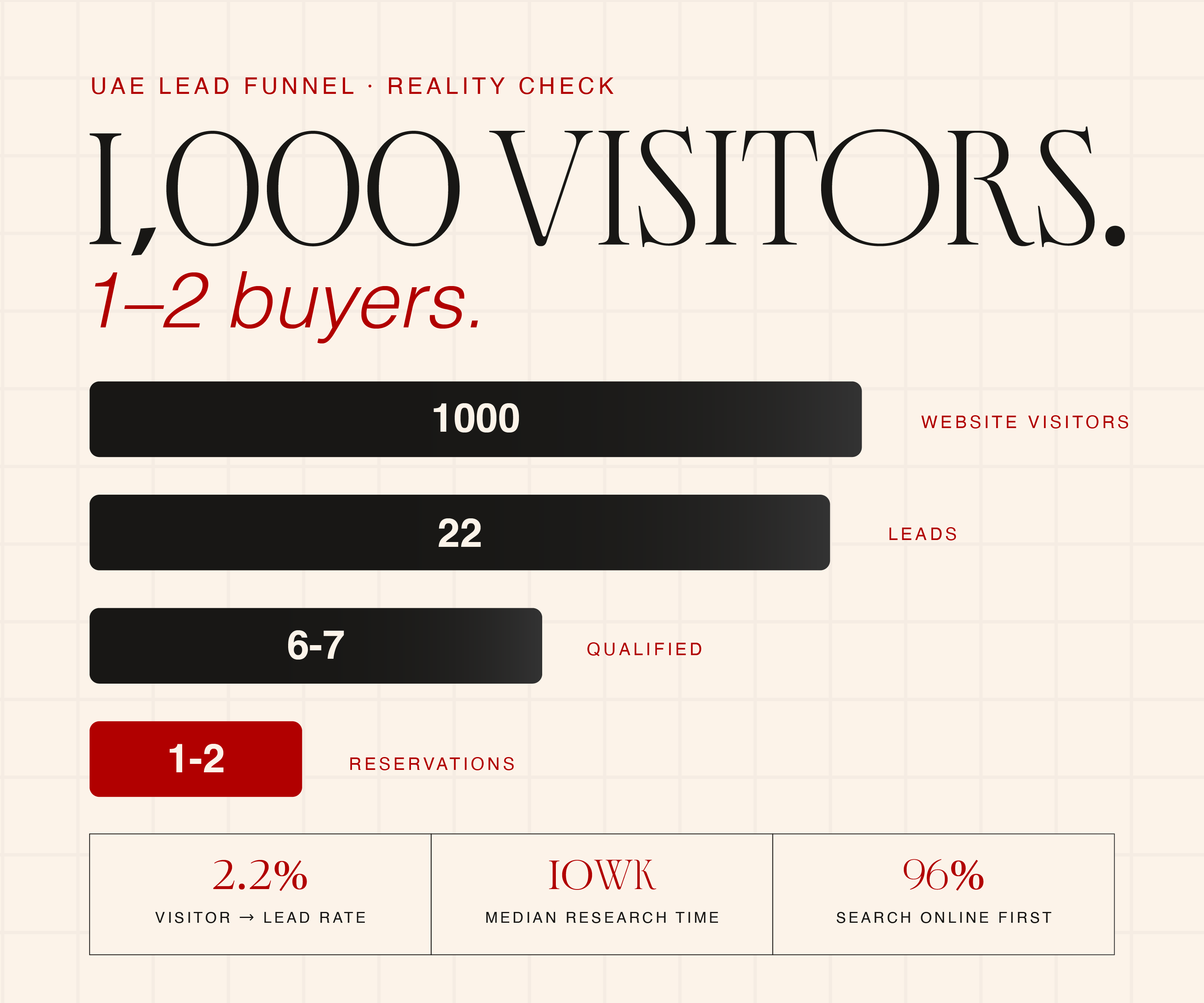
Most development sales teams deal with a pipeline in which MQLs and SQLs are mixed together, tracked inconsistently, and followed up with similar intensity. The consequence is that a sales director’s time is allocated on the basis of recency rather than quality. Leads who enquired last are called first, regardless of their financial profile or stated readiness.
Industry data suggests a visitor-to-lead conversion rate of around 2.2% for real estate websites. This is a useful directional benchmark, but it obscures the metric that matters most: the ratio of leads that ultimately convert to reservations. If that ratio is low, the marketing strategy is generating interest without generating buyers. The precise threshold will vary by development, price point, and market conditions, but the principle holds regardless of scheme.
The Foundations of Effective Marketing for Property Developers
Qualified leads are rarely the product of better advertising. They are almost always the product of better positioning.
Positioning is the deliberate process of defining what a development stands for, who it is for, and why it is meaningfully different from alternatives. It is the foundation on which all effective property marketing rests. In the UAE, where the off-plan market regularly sees dozens of new launches competing simultaneously, this is not optional. When positioning is weak or absent, advertising generates curiosity from the wrong audiences. When it is precise and compelling, marketing attracts buyers who self-select with a higher degree of confidence.
This requires genuine market segmentation. Not the broad categories developers often use — “investors,” “end-users,” “expats”, but specific buyer profiles with defined financial parameters, lifestyle motivations, and decision-making patterns. A luxury waterfront development on Yas Island does not have one buyer type. It has several, like Abu Dhabi residents upgrading, GCC investors seeking yield, European second-home buyers attracted by the Golden Visa , each responding to different messages, using different channels, and requiring a different nurturing approach.
The Urban Land Institute has consistently highlighted product-market fit as a core determinant of development performance. A scheme that is well-conceived but positioned against the wrong buyer profile will underperform , not because the product is wrong, but because the marketing is addressing people who cannot or will not buy it.
Many developments in the UAE fail before advertising begins. When a developer launches without defined buyer personas, clarified differentiation, and a clearly articulated value proposition, the marketing that follows is expensive guesswork. The rigorous approach starts with a demand analysis, an honest competitive review, and a clear positioning statement before any media spend is committed.
Why Branding Matters Before Lead Generation
There is a view, still common among property developers, that branding is a luxury reserved for the largest schemes or the highest price points. The evidence does not support this.
Trust is the primary driver of purchasing decisions in property, and particularly so in the UAE, where a significant share of buyers are purchasing remotely, in a market they may know only through digital channels. A buyer in London, Mumbai, or Moscow considering a significant off-plan commitment in Dubai needs confidence not only in the physical product but in the developer behind it. Brand is the mechanism through which that confidence is established before the sales team has any involvement.
NAR’s 2025 research shows that 35% of sellers identified reputation as the most important factor when selecting a property professional. In a development context, the same logic applies from the buyer’s perspective: a developer’s brand communicates track record, quality standards, and reliability before any conversation takes place.
Knight Frank’s Private Office has noted that at the luxury end of the UAE market, particularly in areas like Palm Jumeirah, Emirates Hills, and Saadiyat Island, demand for highly serviced, turnkey residences has risen sharply. Buyers at this level are explicitly purchasing a brand promise. They are paying for certainty, quality, and a reputation they believe will be sustained. Developments that cannot articulate that promise credibly lose ground to those that can.
The Channels That Power Effective Marketing for Property Developers
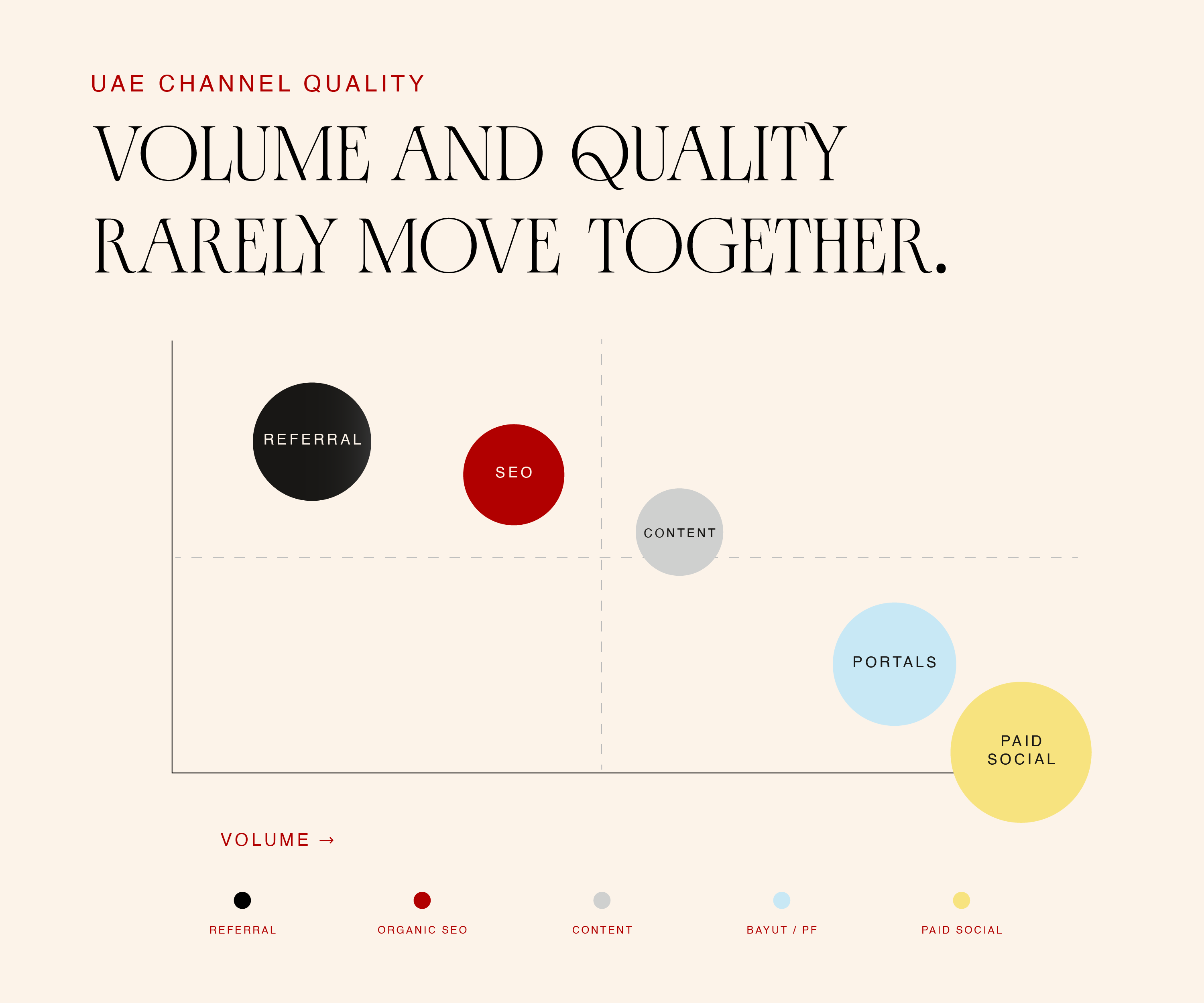
No channel generates uniformly high-quality leads in the UAE. Quality is a function of how a channel is deployed, how well messaging is calibrated, and how systematically leads are qualified after the initial enquiry. That said, certain channels structurally favour quality over volume.
Organic search remains one of the most reliable sources of high-intent traffic in property marketing. According to REsimpli’s 2025 analysis, SEO drives 53% of website traffic for real estate businesses, and search-driven conversion rates consistently outperform social media traffic. A buyer searching for “off-plan apartments in Dubai Creek Harbour” or “Golden Visa property investment UAE” has already self-filtered. The intent is built into the channel.
Content marketing is significantly underused in this sector. Developments that produce genuinely useful content — area guides, Golden Visa eligibility explainers, investment yield comparisons, payment plan breakdowns, attract buyers who are engaged with the offer before they make contact. According to HubSpot’s benchmarks, content marketing generates three times more leads than traditional outbound marketing while costing considerably less to sustain over time.
Referral networks attract leads through existing buyers, agent relationships, wealth managers, and professional introducers. They consistently produce the highest-quality leads across development types. A referred buyer arrives with existing trust, a more defined brief, and converts at meaningfully higher rates than any outbound-generated lead.
Property portals like Bayut, Property Finder, and Dubizzle, remain important for reach, but they are volume channels by design. Portal enquiries require systematic qualification before reaching the sales team. Developers who treat portal leads as pre-qualified are consistently disappointed.
Paid social, particularly on Instagram and LinkedIn where UAE property marketing is heavily concentrated, tends to produce high enquiry volumes with weak intent. The corrective is tighter audience targeting, creative that pre-qualifies buyer profile, and a structured qualification process before any lead reaches the sales team.
How to Measure Success in Marketing for Property Developers
The metrics most commonly reported in development marketing — portal impressions, social media reach, enquiry volumes, cost per enquiry are insufficient. They measure activity rather than commercial outcomes, and they can be optimised in ways that actively reduce lead quality while making the numbers look better.
The metrics that matter are:
Cost per qualified lead — not cost per lead. The distinction forces the marketing team to account for quality rather than raw volume. Two campaigns with identical budgets can produce radically different costs per qualified lead depending on how well the audience is targeted and how rigorously leads are screened at entry.
Lead-to-viewing ratio — what proportion of enquiries convert to in-person or virtual development viewings. In the UAE, where a large share of buyers are based overseas, virtual viewings are a critical qualification stage. A low ratio typically indicates that marketing is attracting the wrong audience, or that the sales response is failing to move interested prospects forward.
Lead-to-reservation rate — the ultimate commercial test of lead quality. The specific benchmarks will vary by scheme, price point, and market conditions, but the direction is consistent: a low rate indicates a systemic lead quality issue, and improving it requires upstream changes to targeting and qualification, not simply more enquiry volume.
Cost per reservation — the fully loaded cost, including marketing spend, sales team time, and overheads, required to produce a signed reservation. This is the metric that makes executive decisions about channel allocation genuinely rational, and it is the one most consistently absent from UAE development marketing reviews.
Customer acquisition cost (CAC) — the total cost of acquiring a confirmed buyer through the full marketing and sales process. Tracking this by channel, over time, is the only reliable way to understand which parts of a marketing programme are commercially justified and which are not.
What Leading Property Developers Do Differently
The distinguishing practices of high-performing developers in the UAE are not complicated. They are, however, consistently applied, which is itself a competitive advantage in a market where strategic consistency is relatively rare.
The most effective developers treat marketing as a strategic function, not a production function. Rather than briefing agencies to generate enquiries, they invest time upstream, defining positioning, validating buyer personas, and establishing what commercial outcome the marketing is designed to produce.
They invest in CRM infrastructure before launch, not after. Waiting until enquiries arrive before building qualification workflows, nurture sequences, and lead scoring models is a recovery exercise, not a strategy. The developers with the best lead quality design their CRM architecture in advance, so that every lead is captured, categorised, and managed consistently from the first day of marketing.
They treat the sales team’s time as a resource to be protected. A common failure mode is allowing senior salespeople to spend equivalent time on all enquiries regardless of quality. High-performing developers implement an explicit qualification stage before any enquiry reaches the sales team, protecting conversion rates and reducing the professional attrition that comes from working an unqualified pipeline.
Finally, the most successful developers approach off-plan marketing differently. Rather than launching with maximum noise and relying on early momentum alone, they build structured pre-launch programmes designed to cultivate a defined pool of genuinely interested buyers before any public release. This approach that is well established in prime residential markets in Dubai, Singapore, and London concentrates attention, builds authentic anticipation, and creates scarcity that is earned rather than manufactured.
Conclusion
The central challenge in marketing for property developers today is not generating more enquiries. It is generating the right ones.
That distinction should inform every strategic decision: how developments are positioned, how brands are built, how channels are selected, how leads are managed, and how success is measured. Volume-led marketing made sense when media was cheap, buyers were less informed, and competition was geographically bounded. None of those conditions hold in today’s UAE market.
The developers who grow sustainably, who launch on time, hit reservation targets, and protect margin in one of the world’s most active property markets are not the ones with the biggest advertising budgets. They are the ones with the clearest positioning, the most deliberate buyer segmentation, and the most rigorous approach to qualifying interest.
Building a marketing strategy around qualified lead generation rather than raw enquiry volume is not a philosophical preference. In the UAE market, where off-plan supply is abundant, international competition is intensifying, and buyer patience is finite, it is the only approach that makes sustained commercial sense.